If you’ve ever stood in a workshop, whether a small carpentry studio or a large construction site, and watched a thick, dense hardwood log get sliced into planks, you might’ve wondered: can a circular saw machine handle that job? As someone who’s spent over a decade supplying industrial circular saw machines to woodworkers, contractors, and furniture makers across North America, I’ve gotten this question a hundred times. The short answer is yes—but it’s not as simple as grabbing a standard circular saw off a shelf and cranking it up to full speed. Hardwood isn’t like soft pine or plywood; it’s denser, often grainier, and more prone to splintering, burn marks, or even kickback if your tool isn’t matched to the task. Today, I’m breaking down exactly how circular saws work for hardwood, what mistakes people make, and how to pick the right machine for your project. Circular Saw Machine

First, let’s get clear on what we’re talking about when we say “hardwood.” Unlike softwoods like cedar or fir, which grow quickly and have a loose cellular structure, hardwoods come from deciduous trees—oak, maple, walnut, teak, cherry, and the like. Their density means they require more force to cut through, and their tight grain can cause blade deflection if the tool isn’t powerful enough. A lot of casual woodworkers assume any circular saw will work for hardwood, but that’s where they go wrong. A standard 7-1/4-inch handheld circular saw, the kind you’d rent for a quick deck board cut, might struggle with a 2-inch thick oak plank; it’ll bog down, burn the wood, and leave a rough edge. Industrial circular saw machines, on the other hand, are built for consistent, heavy-duty cuts, and that’s why they’re the go-to for hardwood applications.
So why do circular saws work at all for hardwood? It all comes down to the blade and power. Let’s start with power: a good industrial circular saw for hardwood should have at least 15 amps of motor power, if not more. That translates to enough torque to spin a blade through dense wood without stalling. Handheld saws usually top out at 15 amps, but when you’re cutting all-day—whether you’re milling rough lumber into beams or ripping 4-inch walnut planks for a cabinet—you need that extra power to avoid overheating the motor. Burn marks are one of the biggest complaints with cutting hardwood; that happens when the blade is moving too slowly, so it’s grinding through the wood instead of slicing cleanly. A high-torque motor keeps the blade speed consistent, even when it’s working through thick, dense material.
Next, the blade. This is the most critical part of cutting hardwood with a circular saw. If you use a blade designed for softwood—like a 24-tooth crosscut blade—it’ll leave a ragged edge, and the small teeth will dull quickly on hardwood’s tough structure. For hardwood, you need a blade with more teeth—usually 40 to 80 teeth, depending on the cut you want. Rip cuts (slicing along the grain) need a blade with fewer teeth, around 40, because they move through the wood faster; cross cuts (slicing across the grain, for finished furniture) need more teeth, 60 to 80, for a smooth, splinter-free edge. Also, the blade’s material matters: carbide-tipped blades are non-negotiable for hardwood. High-speed steel blades will dull after a few cuts on oak, but carbide can handle repeated exposure to dense wood, nails (if you’re cutting reclaimed lumber), and hard knots. I always tell customers: don’t skimp on the blade. A $50 carbide blade will save you hundreds in motor repairs and replacement costs in the long run.
That said, there are limitations to what a standard circular saw machine can do for hardwood. If you’re cutting lumber thicker than 4 inches, or making precise cuts for fine furniture, a handheld saw might not have the depth of cut you need. Most handheld circular saws have a maximum depth of cut of around 2-1/2 inches at 90 degrees, which is fine for trim or small projects, but not for milled planks. That’s where table-mounted circular saw machines come in—they let you adjust the blade height to cut through 6, 8, even 10 inches of hardwood, and the fixed base gives you way more stability than a handheld tool. Stability is huge for hardwood; if your blade wobbles, you’ll get uneven cuts and possibly kickback, which is a safety hazard. A table-mounted saw clamps the wood down, so you can push it through the blade evenly, no slipping, no wobbling.
Another common question I get: can you use a circular saw to cut curves in hardwood? The short answer is no, not usually. Circular saws are designed for straight cuts—their blade is fixed in a straight line, and the machine guides the wood (or the saw) along that line. If you try to cut a curve, you’ll have to make multiple, shallow cuts that follow the curve, which leaves a rough edge that needs sanding, and it’s easy to veer off line. For curved cuts in hardwood, a jigsaw or a band saw is better. But for all straight cuts—ripping, crosscutting, dado cuts (notches for joinery) that are common in furniture making—circular saws are ideal, as long as you match the machine to the cut.
Now, let’s talk about the mistakes people make when using a circular saw for hardwood, because these are the ones that turn a simple cut into a mess. First, not adjusting the blade depth correctly. A lot of new woodworkers set the blade depth too shallow, so it only cuts halfway through the wood, and they have to make a second pass. That second pass can cause splintering or burn marks because the blade is already dull or running at an inconsistent speed. The rule of thumb is: set the blade depth so it extends 1/8 inch past the bottom of the wood. That way, you make one clean cut, no stopping, no second pass.
Second, not using a cutting guide. Handheld circular saws are easy to veer off line if you don’t have a guide, and even table-mounted saws can have alignment issues if the fence isn’t calibrated. For hardwood, a misaligned cut can ruin an entire plank—one wrong degree off, and your cabinet doors won’t line up, or your beams won’t fit together. I always recommend a straight edge, like a piece of aluminum or a level, clamped to the wood, to guide the saw. For table saw machines, regular blade calibration (checking that the blade is 90 degrees to the table) is key—if it’s even a little off, your cuts will be uneven, and you could damage your workpiece.
Third, cutting too fast. Hardwood requires a slower feed rate than softwood. If you push the wood through the blade too quickly, the teeth can’t remove the wood fibers cleanly, leading to splintering, burn marks, and a dull blade. A good rule is: for crosscuts, push the wood at a rate where you can still hear the blade cutting, but it’s not straining. If you hear a high-pitched whine from the motor, that means you’re pushing too hard—slow down. For rip cuts, which are along the grain, you can push a little faster, but still take it easy; ripping oak too quickly will cause tear-out on the bottom edge, which is hard to fix.
Fourth, not maintaining the machine. A circular saw machine, like any power tool, needs regular maintenance to perform well on hardwood. That includes cleaning the blade and arbor after each use, tightening loose parts, checking the power cord for damage, and lubricating the blade arbor to reduce wobble. A dull blade is one of the biggest causes of problems with hardwood; a blade that’s only a few weeks old but dull from cutting softwood will struggle with oak, maple, or walnut. I tell customers to inspect their blade after every 100 cuts on hardwood, and sharpen or replace it as needed.
Now, let’s talk about when a circular saw machine is the right choice for hardwood, and when you might want a different tool. If you’re a small furniture maker, a table-mounted circular saw machine is perfect for cutting planks for tables, chairs, or cabinets. It’s more affordable than a bandsaw or a panel saw, and it’s versatile enough for both small and medium projects. If you’re a contractor building a deck, a handheld circular saw will work for cutting pressure-treated hardwood lumber, as long as you use a carbide blade and cut at a moderate speed. But if you’re doing very precise work, like fine furniture or musical instruments, a circular saw might not give you the smooth edge you need—you’ll probably need a router or a planer to clean up the cuts. But for 90% of hardwood cutting jobs that most woodworkers and contractors do, a good circular saw machine is more than capable.
I’ve seen first-hand what happens when you pair the wrong tool with hardwood. A few years back, I had a customer who tried to cut 3-inch thick walnut planks with a standard 24-tooth handheld circular saw. He ended up burning through three blades, ruining two planks, and damaging his motor from overheating. We swapped him to a 15-amp industrial table circular saw with a 60-tooth carbide blade, and he cut through the same planks in half the time, with clean edges and no burn marks. That’s the difference between a tool designed for the job and one that’s just a temporary fix.
Another thing to consider: safety. Cutting hardwood with a circular saw requires proper safety gear, but that’s true for any power tool. Hardwood is dense, so it can cause more kickback if the blade binds in the cut. That’s why you always should keep your hands clear of the blade, use a push stick when cutting narrow pieces, and wear safety glasses, ear protection, and a dust mask. Hardwood dust is fine, and it’s not just a nuisance—it can be harmful to your lungs, especially if you’re cutting hardwood like teak, which has natural oils that can irritate respiratory tracts.
At the end of the day, the question “Can a circular saw machine be used for cutting hardwood?” isn’t a yes or no—it’s a “which one, and how?” As someone who’s in the business of supplying these machines, I can say that a quality industrial circular saw, paired with the right blade, calibrated correctly, and used with proper technique, is not just capable of cutting hardwood—it’s one of the most efficient and cost-effective tools for the job. Whether you’re a hobbyist woodworker building a new deck, a cabinetmaker crafting custom furniture, or a contractor milling rough lumber for a construction project, there’s a circular saw machine that fits your needs.
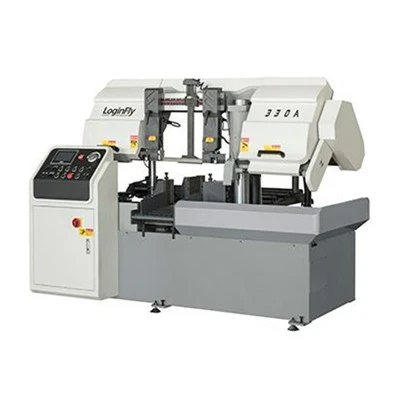
If you’re unsure which circular saw machine is right for your hardwood cutting projects, or if you have questions about blade types, calibration, or maintenance, don’t hesitate to reach out to our team for a consultation. We work with woodworkers of all skill levels, from beginners just starting their workshop to large operations with hundreds of workers, and we can help you find the perfect tool to get clean, precise cuts on every piece of hardwood.
Automatic Band Saw Reference
- "Wood Handbook: Wood as an Engineering Material," U.S. Department of Agriculture Forest Service, 2010.
- "Circular Saw Blade Selection Guide," Woodworking Machinery Association, 2022.
- "Safety Guidelines for Power Tool Operation in Woodworking," Occupational Safety and Health Administration (OSHA), 2021.
- "Industrial Circular Saw Maintenance Best Practices," International Woodworkers Association, 2019.
Shanghai Loginfly Sawing Technology Co., Ltd.
As one of the most professional circular saw machine manufacturers and suppliers in China, our products have good reputation in the market. We warmly welcome you to wholesale premium circular saw machine from our factory. If you have any enquiry about cooperation, please feel free to email us.
Address: Room 506 NO.655 Yinxiang Road,Nanxiangtown,Jiading District, Shanghai.China
E-mail: sales01@loginfly.com
WebSite: https://www.loginflysaws.com/
